Achieving officer accountability and improving agency culture is a challenge for police leaders. Reducing misconduct and elevating internal morale must be aligned with officer wellness.
This article directly addresses how agency leaders can address and improve Accountability and the overall Agency Culture.
Accountability: The balance of reducing misconduct while implementing solutions through training and tools.
Agency Culture: A leader’s primary performance metric is the culture they foster, balancing misconduct reduction while improving officer wellness.
“The best executive, is the one, who has sense to pick good men to do what he wants done, and self-restraint to keep from meddling while they do it.” ~ Theodore Roosevelt
If there is no accountability engrained into every fiber of your organization, gross misconduct can occur at some point… and it can negatively make the evening news.
The Culture of Accountability
Accountability culture requires a commitment to transparency, ethical conduct, and adherence to the law, ensuring that the authority granted to police is not abused and public trust is maintained.
When incorporated properly, emotional intelligence (EI) can improve accountability in a police department by improving decision-making under pressure, improving leadership, and promoting a culture of empathy and trust.
When officers can manage their own emotions and understand those of others, they are less likely to act impulsively, leading to fewer misconduct incidents. Learning where the breakdown occurs is the starting point to improving the culture within.
3 Culture Breakdowns:
1. Allowing Toxic Behavior
Ask employees inside your agency how much time is wasted on negative banter in the workplace, and most say 50% or greater.
This is an unacceptable culture, yet rarely addressed. It’s a constant negative loop that effects everyone inside the organization.
Some Officers who didn’t get promoted, are still complaining about it years later!
2. Banter, Bullying, and Elevated Emotions
Banter and Bullying: Leaders are challenged with where lighthearted banter ends and unprofessional bullying begins. A zero-tolerance standard ensures mental wellness and safety, preserves morale, and prevents formal misconduct complaints.
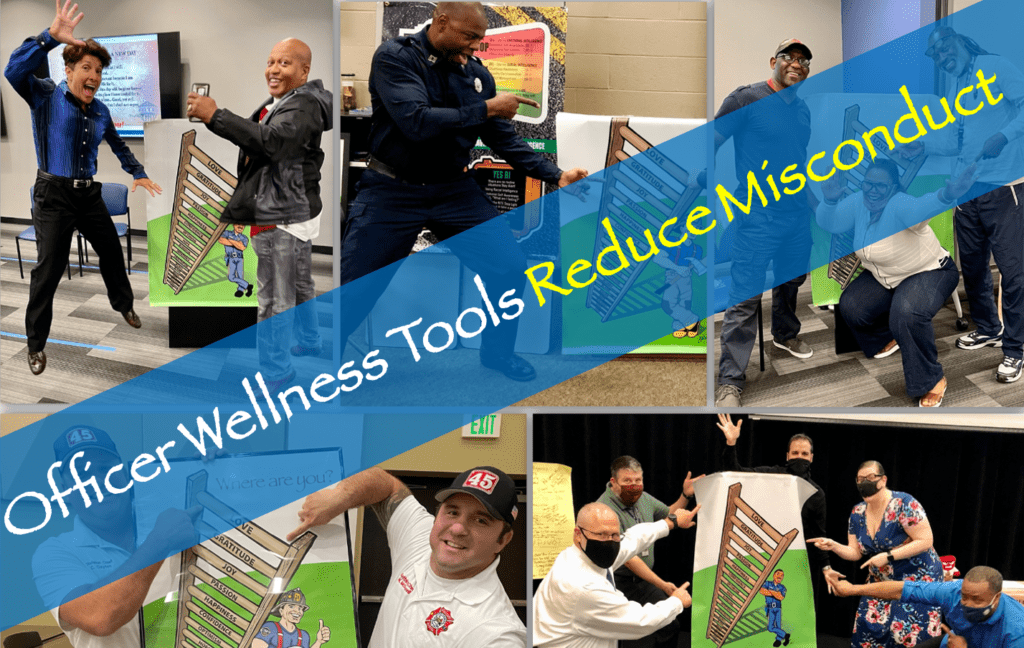
Elevated Emotions: It’s a given that officers work under extreme pressure. Implement emotional intelligence and stress management techniques on a regular basis. When elevated emotions surface, immediately utilize the agency’s wellness and peer support resources, positioning these services as an essential component of officer wellness.
Working under extreme pressure will take its toll. Emotional intelligence techniques can decrease stress, at work and at home.
3. Sweeping Misconduct Under the Rug
As time passes you spend more time listening to toxic co-workers. You can feel something isn’t right, and you are changing for the worse. Things just get swept under the rug, pretending nothing is wrong.
The seasoned supervisor that doesn’t care to make change or to help others, tells you…
“Suck it up, and deal with it!”
“Misconduct will never happen inside this agency” said the Police Chief. Yet when misconduct occurs, they resign, and walk away with full benefits. The city is left to clean it up.
Getting bad press, million-dollar lawsuits, community distrust, and negative media attention, all adds up to low morale and losing good employees.
When an Officer’s gross misconduct leads to jail time, their own lives are at risk, like Dereck Chauvin getting stabbed multiple times while in prison. This is a vicious cycle… and saying it will never happen is only taking a blind eye, while failing to improve an agency’s accountability culture.
You can’t take back 19 seconds!
It is easy to say it will never happen, and take a blind-eye to the one person in the agency that is a ‘ticking time-bomb cop’. Every agency has those officers that ramp up police calls, find a way to get around police protocols, while endangering their zone partners because they just happen to roll up on the call.
How many times have you thought, I wish I had stayed home today. Many innocent public servants have lost their job or gone to jail with the Officer that conducted the misconduct.
Improving Department Culture:
Police Executives know that more emphasis must be placed on improving agency culture.
Professional workplace culture goes beyond your wellness programs, peer support groups, and mental health advocates. These programs are useless if you don’t show a consistent professional workplace culture that everyone follows.
If you take a poll within your agency…
Would most employees say your agency culture is a positive or negative one?
Part of having a Professional Workplace Culture means implementing accountability standards to measure your agency cultural guidelines. The best way to boost morale is to show you care by taking action steps.
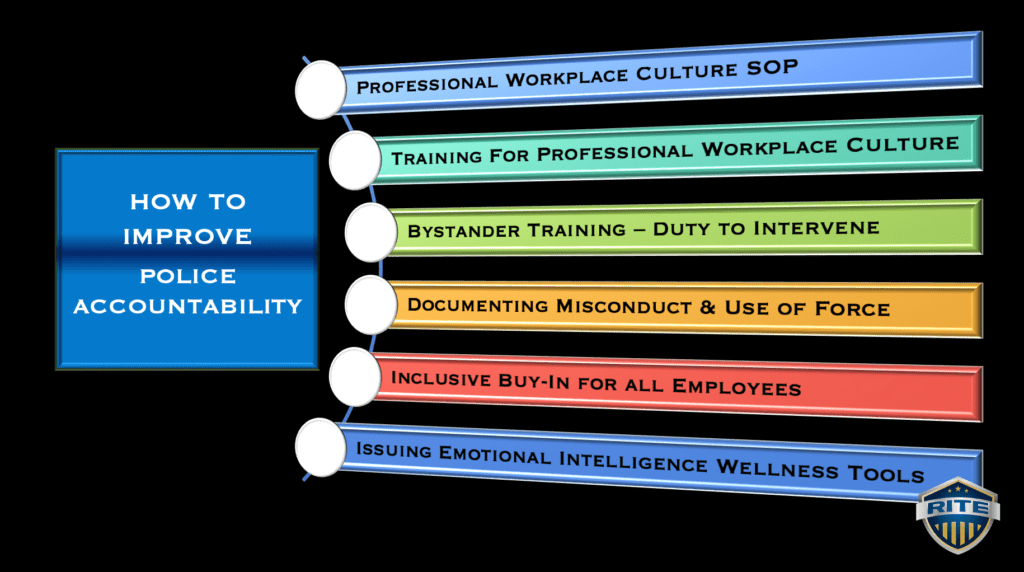
6 Accountability Action Steps:
- Set clear expectations and policies
- Train to improve a Professional Workplace Culture
- Bystander Training with Duty-to-Intervene
- Document misconduct & Use of Force
- Lead by example
- Issue Emotional Intelligence Training & Tools
It is not just about having a professional workplace culture policy and giving one-and-done check the box training. Most handouts will get thrown out just after class, and most won’t remember or CARE about it. Leaders should also be in class to uphold the training once it has been completed.
Inclusive Buy-In is the key to success. When all employees pledge to do their part, the culture will strengthen.
RITE’s cognitive imprint tools help employees improve the professional workplace and accountability.
About RITE
Since 2015, RITE Academy has trained over 2000 police agencies in Emotional Intelligence. Helping officers on how to recognize the onset of Block Out Syndrome. RITE Training uses physical cognitive imprinting tools, giving the officer better control of their own emotions in every situation.
RITE Training helps ALL public servants improve internal communication that improves communication and de-escalation. When you learn to control your emotions, you learn to control every situation, and help others that are in need. Contact us on how to bring RITE to your agency.